Or: How We Accidentally Turned Everyone Into Helpless Specialists
Remember when people used to know how to do things? Like, actual things?
Picture this: It’s 1823. Some guy named Gerald is sitting in his workshop, crafting a shoe from scratch. He knows leather like the back of his hand. He cuts it, stitches it, shapes it, polishes it. Gerald is a legend. He makes two shoes a day, and honestly? Gerald is living his best life.
Fast forward to today. Gerald’s great-great-great-grandson works in a shoe factory. His job? He glues the left insole. That’s it. Just the left one. The right insole guy is in a completely different department, and they’ve never even met.
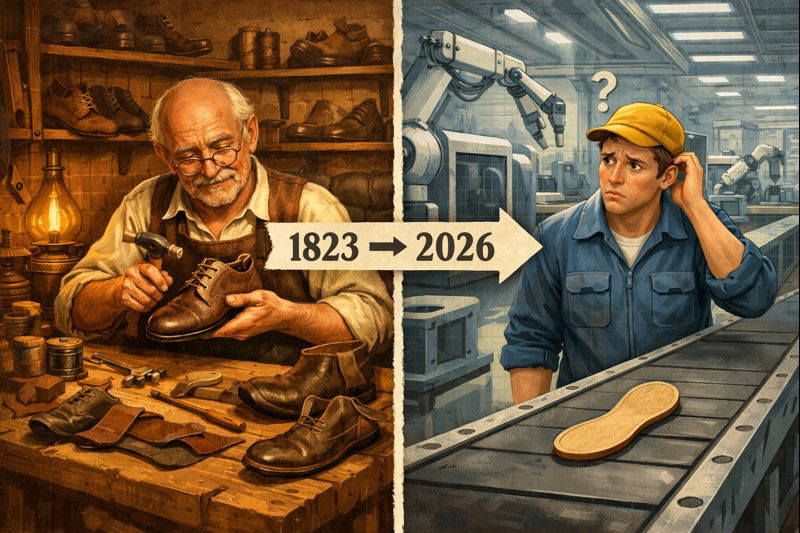
Progress! 🎉
Sure, we’re now making 10,000 shoes a day instead of two. Sure, everyone has affordable footwear. But here’s the thing nobody wants to talk about: Gerald Jr. has absolutely no idea how to make a shoe. If you asked him to craft one from start to finish, he’d probably just stare at you like you’d asked him to perform open-heart surgery.
We didn’t just increase productivity. We demolished knowledge and scattered its pieces across an assembly line like confetti at a divorce party.
The Great Knowledge Heist Nobody Warned You About
This is the pattern of “progress” that haunts us everywhere. We solve one problem and accidentally create three new, weirder ones that nobody saw coming.
Take the modern job market. Please. Take it.
Back in the ancient times (aka 15 years ago), getting a job was relatively straightforward, if soul-crushing. You’d send your resume to an HR person. They’d read it. Maybe they’d call you. You’d have an interview. They’d tell you what they didn’t like. You’d adjust. It was a conversation, however painful.
Now? Now you’re shouting into the void while robots judge you.
Welcome to the Black Box of Eternal Rejection
Today’s HR departments have “optimised” the hiring process with AI-powered ATS systems, job aggregators, and enough automated filters to make a spam folder jealous. They wanted to “eliminate the noise” and “increase efficiency.”
Mission accomplished!
They eliminated the noise so well that they also eliminated:
- Human feedback
- Any sense of what they’re actually looking for
- The candidate’s will to live
- Their own ability to find good people
Candidates now exist in a special kind of purgatory, endlessly tweaking their resumes with keywords they found on some LinkedIn influencer’s post at 3 AM, desperately trying to please the algorithm gods, never quite sure if they’re applying for a real job or screaming into a digital void that occasionally auto-responds with “Thank you for your interest.”
“We’ve decided to move forward with other candidates whose synergistic value propositions better align with our dynamic, innovative, rockstar-ninja paradigm shift.”
Translation: ¯(ツ)/¯
The feedback loop is dead. Candidates have no idea what they’re doing wrong. HR has no idea what they’re missing. Everyone is miserable, but hey, at least the process is efficient.
The Curse of Knowing Less and Less About More and More
This is the cruel joke of modern progress: we keep solving problems by breaking knowledge into smaller and smaller pieces, then acting shocked when nobody can see the whole picture anymore.
The cobbler knew shoes. The factory worker knows left insoles.
The job seeker knew how to impress HR. Now they know how to trick an algorithm (maybe).
The HR person knew how to spot talent. Now they know how to configure filters in a portal called “Naukri” (and pray it works).
We’ve become a civilisation of hyper-specialized people who are collectively helpless.
Everyone’s waiting for someone else to complete the next step, except nobody’s quite sure what that step is anymore, or who’s supposed to do it, or if it even needs doing.
So What Now?
Here’s the uncomfortable truth: we can’t go back to the cobbler days. Gerald’s workshop isn’t coming back, no matter how many artisanal, small-batch, locally-sourced Instagram accounts we follow.
But maybe ‘just maybe’ we could occasionally ask ourselves: “Are we solving a problem, or are we just creating a fancier, more complicated problem that we’ll pretend is progress?”
Maybe we could build systems that increase productivity without lobotomising everyone in the process.
Maybe we could automate hiring and keep the human feedback loop alive.
Maybe we could admit that sometimes, progress looks a lot like we’ve just broken something that used to work and convinced ourselves it’s better because there’s an app for it now.
TL;DR: We turned shoe-making into an assembly line and lost the cobblers. Now we’re doing the same thing to hiring, communication, and pretty much everything else. Productivity is up, but so is our collective confusion about how anything actually works. Progress!
Now if you’ll excuse me, I have to go update my resume with more keywords so the robots will love me.